Tuesday, 27 August 2013

Tim Sharp


Just as I thought law firm communication was becoming more about the visual, designer Tim Sharp at Moore-Wilson tells me that cutting edge websites are in one sense far more about text and content these days. I’m baffled. I know of one Top 20 law firm that has “visual differentiation” as a key strategic point. And as today we have the opportunity for far more immediacy in the creation of vodcasts and other video-style content on websites and social media platforms, etc, I thought we were moving towards a greater emphasis on visual rather than textual communication across the board: we’ve had YouTube since 2005 and now we have a plethora of channels focussed on the visual – Flickr, Instagram, Pinterest, Vine, Tumblr; and in the legal profession we’ve also witnessed the freeing up of law firm colour palettes (from grey to blue as discussed in one of my July blog) that would never have been tolerated in the pioneering days of law firm marketing. Well, it was the 1980s; moreover solicitors and barristers alike have been on a long journey to understand what “branding” means in the context of a legal business. It’s taken about 20 years for most to understand the difference between brand values which run very deep, essentially summarising partners’/members’ commonality of purpose, versus the more superficial outworking of this, logos, which were typically lawyers' first pre-occupation in the brave new world of legal marketing. They now know they are only just one of the visual manifestations of brand values.

But are we now to understand the visual is less important?

“The point is that “Look & Feel” is just one aspect of design." Tim tells me. "Functionality is equally important. What we’ve learned is how to work the relationship between form and function to best effect to engage key audiences through a website. New technologies have enabled so many different new ways to put over content, we can think so much more creatively about how to engage. I’m happy to say also that law firms have got so much slicker about this in the last few years: a typical starting point for them now in building a website is to think about “user journeys”: stepping into the shoes of clients and contacts and others who will be using the site; understanding what they will be looking for (of course Google Analytics tells us so much about what site visitors are looking at when they visit, and law firms have learned to use this data to refine their sites or when designing new sites from scratch); making this information easy for them to find/access and then planning information you want to “push” to them around this. Some of the content may be delivered in a visual way – eg vodcasts and videos, diagrams, animations, etc. But home pages rely far less on overwhelming branding and wizzy colours/visuals. They focus far more on text signposting clear pathways through the site to the information most visitors will be after.

"Part of this is definitely driven by SEO [Search Engine Optimisation] and packing home pages with words that will maximise a firm’s Google rankings [ie how searchable they are when people google eg the term “legal advice”]. Although currently there is a big debate about whether SEO is dying and being taken over by social media...

"But in part it’s about all of us developing a better understanding of the appropriate balance between words and images in communication and a deft use of both to put the right messages and impressions across in a way that engages with your audiences in the way they want to interact with you. The web design industry has a lot more functionality to play with now so is able to perfect the balance between form and function much better, and use this to engage with website users far more effectively. The top law firms have got this too, as much as everyone else in the broader business world.

I have written in this blog before about the gradual shift in our culture towards visual rather than textual information. And regular followers will know this is a theme covered by one of my all-time favourite films, Fahrenheit 451 (the title coming from the temperature that paper burns, apparently). They may not be on physical paper so much any more, but good to see that words are holding their own!
***
On the subject of new ways to communicate visually, my newly downloaded Vine app has been growing on me. It has taken my tweeting to a whole new level! How nice to be able to share more of what I'm doing by posting six-second video clips of the people I meet.

I read this week that in seven months since its January debut, Vine users have climbed to more than 40 million. Having trialled it this week, I completely see how it's managed to wrap its tendrils so tightly around our Twitter habits in such a short space of time. It's addictive!

Here's a Vine I posted this week featuring Kysen friend and head of arbitration at Stewarts Philippa Charles and her amazing revelation that she uses Shoes of Prey to design her own shoes. As another friend Charlotte Ward said to me when I showed her, this is the PERFECT Twitter story for me: new social media toy, creativity... and of course shoes!
***
From light to shade, another more serious Vine I tweeted this week told the amazing story of the Big Issue salesman who works outside our office on Long Acre (Covent Garden). 

Unbelievably he's been studying for a Masters in Psychological and Psychiatric Anthropology at Brunel University, his dissertation focussing on life as a homeless or housing-challenged person in London, and has just been awarded a distinction. People never cease to surprise me. Nice to see how much this story was re-tweeted and favourited. It's an inspiration.


Sunday, 18 August 2013

Sophie Hann


Astonished to learn client Sophie Hann is literally living inside one of my favourite legal topics. Of all the editorial angles we've taken on the credit crunch, my favourite has to be the rise of the pop up shop, temporary art installation and peripatetic living space, as property owners find wonderfully creative and colourful solutions to the problem of vacant properties blighting our communities as well as being open invitations to squatting and crime. By day Sophie runs the marketing team at longstanding Kysen client Intangible Business, the IP valuation specialists who have written the blueprint for this very specialist discipline. (Not content with leading the market in the UK for brand valuation in the context of M&A or commercial disputes, they have recently been advising overseas governments on developing frameworks for emerging IP valuation professions). But I learned only this week that outside working hours Sophie is a "live-in guardian" making her home in disused commercial properties as part of a scheme to provide live-in protection to vacant buildings waiting for the appropriate planning permission or funding before being developed. I was fascinated! What a contrast she must see every day as she transitions from the consumate professional she is at IB during the day, to the artsy loft-liver she is of an evening. Just imagine making your sitting room in the middle of a 1000-square-foot former office space! It may not be your cup of tea, but in my filmic fantasy life it most definitely is. Well, okay, maybe the nomadic element to the lifestyle is not so appealing, as Sophie will need to move from place to place only staying in one location for a short period (I've chosen to live in the same house for 18 years after all). And maybe communal living is not my thing either (if you discount family life). But hey, this is what fantasies are for: appealing scenarios that absolutely don't work for you in real life.

I've
always seen Intangible Business as creating the mould, leaving others to do the copying. So perhaps Sophie's unconventional approach to central London living is not so surprising. We discussed this as we talked about her plan for the next stage of marketing IP.

"Intangible Business is well known in legal spheres now and our founders Thayne and Stuart have a clear voice in legal media that people listen to. I'm now on a mission to make sure everyone is aware just how far ahead of even their closest competitors they are. These guys created the blueprint for IP valuation and they continue to innovate everyday. The work they do for foreign governments really shows the level they and the team work at: advising on how to set the new rules for IP valuation.” 

This lady has spark. We know her ambition. Now let's watch this space...
***
This week's Red Bull Bullies story proves my point that litigation and reputation should always be thought about in tandem. I've seen so many own goals by the other side when managing press coverage of court cases, where a clever, persuasive line of argument wins the legal point maybe, but threatens thoroughly to trash a company's reputation so the legal team is forced to cave in in any event. Red Bull had challenged tiny Norwich-based Redwell Brewery that its name infringed a Red Bull UK trademark in an attempt to stop them using it to trade. A social media storm ensued leading to headlines on mainstream media about Red Bull Bullies. The global energy drink giant had tried to argue that the name Redwell was problematic because in addition to the use of the word Red, both "well" and "Bull" ended in "ll". Given this attention to the phonetics and graphemics of the matter, did it not occur to them that the "Bull" in their own name lent itself only too easily to headlines of Bullying?
***
A-level results day set me thinking... This year Weightmans market-leading Higher Education team has taught me a lot about how university business has changed. Their funding depends more today on their ability to attract students, whereas in my day it was far more about research grants. The knock-on effect of this strategic change gives rise to all manner of legal issues, not least how staffing levels are configured around business need and how carefully this needs to be managed when things transition. A case in point is the latest trend for universities to offer cash "sweeteners" to the UK's brightest students following new Government rules allowing universities to offer unlimited places to ABB-plus students. 

But this week I have to say my interest in the subject was much more personal as my eldest landed himself a place at Lancaster Uni to study English with Creative Writing #proudmum. Although reality is now sinking in that the first of my chicks will be flying the nest... far too soon!

Nice to be able to share these mixed emotions on Twitter. Bonded with a few other mums and dads in the legal sphere and made some new friends. Good to remember all of us are working to live, not the other way around. :)

Monday, 12 August 2013

Ben Rose


The timing of my breakfast catch-up with criminal solicitor supremo Ben Rose was perfect: on my first day back from my Summer break I was keen to find out what my friends in the legal community really thought of the outrageous story that hit the headlines earlier this week about the defence barrister in the Neil Wilson rape trial accusing the 13 year old victim of being "predatory" and of having "egged the [41 year old] defendant on"!  What!?  Is this the sort of justice a 13 year old rape victim is to expect?  That can't possibly be right in an English court of law.  No sorry, that was my mistake. The defence barrister didn't use those objectionable terms. .....it was the Prosecution counsel. And the judge!!

Now I strongly believe that a defendant is innocent until proven guilty.  And also that defence lawyers need to (and should) do whatever they decently can, to provide their client with the most robust defence possible.  As discussed in this blog before, these principles are key not only to protecting innocent people caught up in the criminal justice system, but also to ensuring convictions of the guilty are secure and can't be easily challenged or unravelled. But for even a defence barrister to suggest a 13 year old can in any way be responsible for a 41 year old rapist's actions would simply beggar belief. And as for a prosecutor.... !

If anyone could put me straight on this issue and get me to think about it differently, it would be Ben - whom I personally respect and admire and who is widely acknowledged as one of our very top criminal defence solicitors, famous for handling some of the most high profile investigations and court cases of recent years.  I've known Ben and his colleagues at Hickman & Rose for years. We caught up briefly at The Lawyer Awards this June (he was shortlisted for the Client Partner of the Year award, having been nominated by not just one but several clients) and we promised ourselves a proper catch-up over the summer, hence this week's breakfast.

A lot of Ben's work I can't talk about, as his work for high profile (sometimes celebrity) criminal defendants is often confidential. One public role he had that I can mention though, is his work for a certain media mogul and his son in the midst of one of the most significant inquiries into media ethics we have ever seen - yes, you've got it: Leveson. He is increasingly the Number One choice for any high profile individual caught up in a criminal matter, whether as a defendant or a witness. What I hadn't appreciated until our discussion over coffee this week is that he leads the way in challenging the criminal justice system itself, having run a number of Judicial Reviews of the CPS. I was fascinated. So he's actually taken the CPS to court?  "We'll, the CPS of course has a duty to all concerned to run their prosecutions properly. Victims and other witnesses may be risking a lot personally when speaking out in open court to help a prosecution. It is only right that those prosecuting are held to account. There can be serious repercussions, particularly where victims and witnesses are known to the perpetrator. If prosecutors have failed to pay attention to an important detail, or procedural step, or an obvious line of questioning, then of course they should be challenged."

This is what prompted me to ask Ben about the Neil Wilson case and whether he thought a line had been crossed. I'm pleased to report that I can't actually print his immediate response, it was so full of expletives. It ran along the lines of "Extraordinary! How does that thought ever occur to someone? What were they thinking! What planet were they on!" except in much more colourful language. He continued in a more measured tone: “At least Cameron waded in and it looks like the attorney general is going to review the ridiculously lenient sentence. [Wilson walked free with just an eight month suspended jail sentence]. Just parking the clearly barmy thinking in this case for one moment, the story does raise a serious debatable point about the fitness of our adversarial system. It is most unusual to find the prosecutor, defence and the judge in agreement, and perhaps that should have been an indication things were going wrong.  But as we well know, the problem doesn’t start in the courtroom.  The insensitive treatment that many rape victims get at the hands of the laddish police culture  in the first stage in an investigation has long been criticised.  All sorts of measures have been brought in to change this experience, but in reality the problem pervades the whole justice system. I have to say though, even acknowledging these ongoing systemic issues, what happened in the Wilson case is utterly unbelievable and I hope we never see anything close to it again for a very long time."

Well, so it’s not just soft lay people like me who have such a big problem with the Wilson case. Even those who could be forgiven for being rather battle-weary through constant exposure to the criminal justice system are shocked. Even this leading criminal defence lawyer who knows more than most the importance of doing everything decently possible to give your client the best, most robust defence. Did you spot that word there? “Decent”? This is what we expect of our criminal justice system that we are normally so proud of. The Wilson case most definitely crossed the line. No debate.  


***
So Saudi Prince Al-Waleed bin Talal has finally been brought to account. Regular readers of this blog will know I interviewed TLT's Richard Waller last month, the solicitor leading Mrs Sharab's case against the billionaire prince for for non-payment of a £10 million-plus commission brokering the sale of one of the Prince's private jets to libyan leader Muammar Gaddafi. At the time I relayed reports of the prince's extraordinary evasiveness in the court room, Judge Peter Smith's comments about his 'capriciousness' making headlines. But worse was to come with his judgment: he branded the nephew of Saudi Arabia's King Abdullah a wholly unreliable witness, saying  "It is not necessary for me to determine that he was telling lies in the witness box. He came close to admitting it..." Clearly comments from the Prince in the course of cross-examination such as "You might call it a lie, I call it a tactic." didn't help his case!

Mrs Sharab, on the other hand, was described as an impressive witness and I love her quote in response to the judgment. "Today's decision has reinforced my belief in the fairness and impartiality of the English courts." No wonder wealthy foreigners continue to queue up outside the Rolls Building for a slice of British justice.  
***
Huge thanks to my friends at Bonelli for such great recommendations for my trip to Venice this month. Andrea Carta Mantaglia and Alberto Saravalle were kind enough to share some of their top tips for making the most of even the shortest visit to this very special place.

Now, I have always associated Alberto with Milan, Rome and New York as he spends most of his time between these three so I hadn't appreciated that he actually comes from Venice. Not only that but his family have been there since the 1400s. Clearly there aren't many people who know this charmed city better! I won't divulge some of the more personal recommendations my friends gave me, as I know what a privilege it was to be let in to some of their secrets. But I will urge you to explore the islands around Venice if you haven't ever done this. They're exquisite, each with their own waterway system instead of roads. And if you're travelling this summer, do visit the wonderful art festival dotted around the city. Biennale only takes place every two years (the clue's in the name) and runs until November.  


Wednesday, 24 July 2013

Anne-Marie Kruk


Anne-Marie Kruk has Something on the Brain and insists we should be talking about it. She's working hard to break down barriers, shift preconceptions and get more people talking openly about it. She says a lot of harm is done by people feeling uncomfortable about it, being coy, brushing the issue under the carpet and avoiding discussing it directly. This is exactly how misconceptions about it are perpetuated she says. And what is this elephant in the room? Epilepsy.

"There are so many assumptions made about epilepsy - that sufferers can't ever drive to name just one. That it is totally incapacitating so impossible to live a normal life if you have it, to name another. This is so unhelpful and can be a real block to ordinary people being included in activities - even disadvantaging them in the jobs market. These misconceptions can stop epilepsy sufferers leading fulfilled lives and that's such a shame.

"It's a simple step forward, but I really think that by starting to speak out about epilepsy, some of the stigma and misconceptions around the condition will disappear." Anne-Marie has started a campaign aimed at doing just this: Something on the Brain - speaking out about epilepsy. "We want to get people talking about epilepsy, connecting with new people and sharing their own experiences with the condition. In particular we want to take this message onto the streets, into schools and universities etc, so we have a chance to make a real impact on lives that are still forming. The aim is not only to change the way people think of epilepsy, but be a friend to those with epilepsy too." Given she is targeting the next generation, it's no surprise her awareness raising campaign focusses on Facebook, Twitter and Pinterest as well as a website. 

"We also want to re-write the checklist of what to do when someone has a seizure, because the list of first-aid pointers we've all grown up with just isn't that helpful - eg making sure the individual doesn't swallow their tongue. It's now known to be a physical impossibility to swallow your own tongue!"

In the nicest possible way, Anne-Marie ambushed me into a photo-opportunity when we met, thrusting an inflatable microphone (the symbol of her campaign) into my hand and snapping me to add to her online photo-board"My hope is to get the microphone pictured everywhere with people from around the world, and start an epilepsy awareness revolution!" she enthuses.

You know, seeing her passion about the subject this week, and the wonderful creativity she is putting in to her campaign, I believe she will.

If you would like to have your picture taken with Anne-Marie's inflatable mike, appear on her photo-board and do your bit to raise awareness of the truth about epilepsy, you can drop her an email.
***
Law firm branding: look how far we've come! Lucy Burton's feature (The Age of Marketing) in the current edition of The Lawyer magazine sparked a lot of discussion in the marketplace. At least half a dozen people brought it up in conversation spontaneously as we went about our normal business this week. The Lawyer does have a knack for writing the features that everyone else talks about... If you haven't had the chance to get to read beyond the headlines and get to the detail of the piece, do make time to have another, more thorough read. The "Colour Me Legal" wheel particularly caught my eye, showing the distribution of Top 50 law firm branding across the colour spectrum and the number of firms clustered in the blue zone (11 firms, discounting those favouring turquoise) and the black (9 firms).

Takes me back to the earliest days of law firm marketing, when the first brochures appeared after the Law Society restrictions on marketing were relaxed in 1987. (Yes I've been around that long - you're too kind saying I don't look old enough!) Satirical cartoonist Ken Pyne drew this wonderful cartoon for The Times (above left) depicting the new dialogue emerging between design agencies and law firms. As you'll see the colour palette of choice in those days shows how lawyers simply weren't ready to step on to the colour wheel at all: "dependable grey", "solid grey", "honest grey", "long and established grey" preferred over "untrustworthy and bent cerise". There really were a lot of grey brochures around in those days! As I say, in 25 years we've come a long way...
***
The other most talked about story was of course the revelation that two love-hungry American ladies in London have compiled a list of Barrister "Hotties". Thankfully amid cries of "would we put up with this if it were about women?" There is a serious point there, but it didn't stop the legal masses (and most of the Kysen team too it has to be said) chortling into our cappuccinos. It wasn't long before Telegraph journalist (and Kysen friend) Patrick Sawer picked the story up and ran a marathon with it.

My beef with the ranking though is that it's hardly definitive. For example how can these ladies have missed the heartthrob QC who sent one jury member so a-quiver during one of the top murder trials in recent years that she sent him a love note... which of course had to be declared to the judge as she could hardly be considered independent, given her emotional proclivities. The jury had to be disbanded and a new one sworn in. Our QC was more than a little embarrassed and of course he was ribbed mercilessly by his fellow members. I won't name him as he has clearly worked hard to keep himself off the Hotties list.  Just think how many others have done the same. Remember, in the world of PR, sometimes the busiest jobs are keeping people out of the news.   

Monday, 8 July 2013

Richard Waller


From Wallace & Gromit to Saudi Royalty: Richard Waller's life at TLT is certainly varied. As regular readers of this blog will know, I caught up with our friends at TLT last week in Bristol at the firm's charity auction marking the start of Nick Park's "Gromit Unleashed" campaign to raise money for Bristol's Children's Hospital. This week I met Richard in London, where he is running the high profile case against Prince Al-Waleed bin Talal, a nephew of Saudi Arabia's King Abdullah in London's main commercial court in the Rolls Building, famous for hearing so many disputes between the world's super-rich. Did you know (all you litigators will...) that last year more that 60 percent of all cases in our commercial courts involved a former Oligarch or super-wealthy Eastern European Businessman? This year seems to be the turn of the Middle Eastern Very-High-Net-Worths. 

The story behind the law suit is highly exotic: the spat is over a luxury plane (worth 120m pounds owned by the prince. It has a jacuzzi. You get the picture.) and the value of Richard's client's close business relationship and personal friendship with the buyer, none other than former Libyan dictator Colonel Gaddafi. Mrs Sharab claims her go-between role was essential to the negotiations and is claiming the 10m pound consultancy fee she says she was promised, but never received. A particular coup for TLT is that Richard's case is apparently the first time that a member of a Saudi Royal Family has been cross-examined by a British QC. And what a grilling he was given! Headlines such as "Billionaire Saudi Prince branded capricious in court" have sped round the world. The court reports have been full of how evasive the Prince has been to Clive Freedman QC's questions. Judgment is yet to be handed down and of course we have no idea what Judge Peter Smith will decide, but it certainly gives a client a good feeling to see their opponent so reduced in the witness box. At the very least Mrs Sharab knows her legal team have done a good job!

But what I wanted to know was Richard's view of why so many overseas business men and women are choosing the London courts to fight their battles. 


"First and foremost overseas litigants recognise the English courts to be incorruptible and to provide fair and balanced justice.  London lawyers have built a first class reputation for handling large and complex litigation with innovative pricing arrangements.The UK legal system is one of the best in the world. Some would say the best. In an age where the other cornerstones of our democracy have been so badly damaged, not least the reputations of our political system and the journalistic profession, we should be very proud that our legal system is so revered and respected."

Well said Richard. Let's hope Chris Grayling is reflecting on just this as he reconsiders the Government's attacks on Legal Aid
***
Good to have both Sophie and Adele back in the office after their Glasto galavant. Weren't they lucky with the weather! Their wellies hardly got an outing. And Adele came back a decidedly sun-kissed shade. If you know her, you'll appreciate our surprise. What I wanted to know though, was whether the Rolling Stones lived up to expectation. What was their performance like? "Energetic!" was the definitive reply. 

Our Adele has strong views on how jibes about how old the group looked have been allowed to circulate freely. Age discrimination, surely! As Adele said, if the comments were anti-women or anti-gay, people wouldn't stand for them so why is laughing at oldies acceptable?

I enjoyed The Stone's performance, and the rest of Glasto on TV from the comfort of my home sofa. Now that does have something to do with age! :)
***
Perfectly timed for Independence Day this week, Covent Garden has welcomed two new major US brands to the neighbourhood. Two classic American restaurant chains opened their first UK stores this week, Shake Shack in the piazza and Five Guys on the corner of our street, Long Acre. Queues have been snaking around the block all week. Well, we do like to be the first with the trends in this part of town you know... 

A little (blue) bird told me @saysitstraight is planning to review them for us as soon as the queues die down! We'll post the link here as soon as she does. Thanks Nicky!

Tuesday, 2 July 2013

Ronke Phillips


Thankfully there are some reporters giving the now rather battle-weary journalist profession a good name. ITV News Senior Correspondent Ronke Phillips is definitely one of those. I first met Ronke at the Amnesty Media Awards in 2012 when she won a prize for unearthing the awful truth behind the Torso In the Thames story and her shock revelation that ritual killings are taking place in our very own Capital. I saw her again at this year's Awards as she stepped onto the stage a second time, winning for her coverage of the ritual killing of another child, Kristy Bamu. As I have said before, after all the press-bashing we have seen throughout the Leveson Inquiry, which quite rightly hauled the media to account for some shockingly murky practices, it is nice to be reminded that some journalists' motives are quite heroic. 

I was keen to know what motivates Ronke to work to such a high standard, sufficient to win an Amnesty Award two years running. She takes a degree of personal risk zoning in on such difficult stories and I was interested to know why she would take this risk, rather than going for an easier life. In particular I was keen to get to the bottom of how journalists like Ronke are wired, in contrast to their more cynical counterparts. 

"It may sound like a bit of a cliche, but I am a news junkie and I also strongly believe in giving a voice to those who, for whatever reason, are unable to speak up for themselves. 

For me journalism has never been about just covering the day to day agenda. I'm interested in the stories behind the headlines, the human angle. These days there is less money and time for this type of journalism but if you put up a good fight for the stories you believe in, you  will get the backing to cover ones that matter. I can be like a ferret when I get wind of a worthwhile story. Tenacity is often the best policy!

The "Torso In the Thames" story became an obsession for me for various reasons.  He was a defenceless child and like me he was Nigerian. It was the most despicable crime imaginable and I believe it is important he is not forgotten. The story behind my nomination for this year's Amnesty Award was also the murder of a child. Kristy Bamu was killed by members of his own family because they believed he was possessed by demons. 

Both stories were difficult to cover emotionally. It is never easy dealing with the murder of a child. Both suffered very brutal, very violent deaths. The details could really traumatise you if you allowed them to. Interestingly I have never felt I was in any real physical or personal danger.  I am Nigerian so that country and its people are familiar to me. Kinshasa was a different story. The remnants of the war are still very evident and although the people were friendly generally, there is still quite a lot of tension and hostility toward outsiders. We had a few tense moments; crowds attracted by the camera voicing their disapproval loudly and angrily. Thankfully we had a brilliant minder who managed to calm things down." 

I was also keen to know about the support Ronke gets from ITV News, and whether the Amnesty Media Awards can help in enabling journalists to get story ideas approved and funded.

"Being recognised by such a prestigious organisation like Amnesty is incredible. It 'validates' me as a journalist and hopefully means my ideas are given a little more credibility but ultimately pieces are commissioned because they are solid, worthwhile, interesting stories which need to be told." 

As our conversation draws to a close, her parting line is: "As for being a hero... I wish!"

Ronke, you may say that, but others would disagree!
***
Had fun visiting Gromit in Bristol this week. You will have seen that Nick Park's Gromit Unleashed charity campaign to raise funds for the new extension to Bristol's Children's Hospital made national TV news this week, as 80 Gromit statues were moved into position in and around the city. 

TLT have sponsored one of the statues, painted by children's illustrator Hannah Cumming. And this week they held a charity auction at their offices to raise further funds for the hospital, timed to coincide with the "unleashing" of the Gromits. It was a lovely opportunity to catch up with some old friends in the TLT team and make some new ones. Nice to get reacquainted with Bristol too. One of my favourite cities. 

If you'd like to contribute to The Children's Hospital fund, you can make a donation here.
***
The Lawyer Awards was a glitzy affair this week. Those of you who know me well will appreciate the sacrifice I had to make, putting on my glad rags and spending an evening partying. But I took one for the team. 

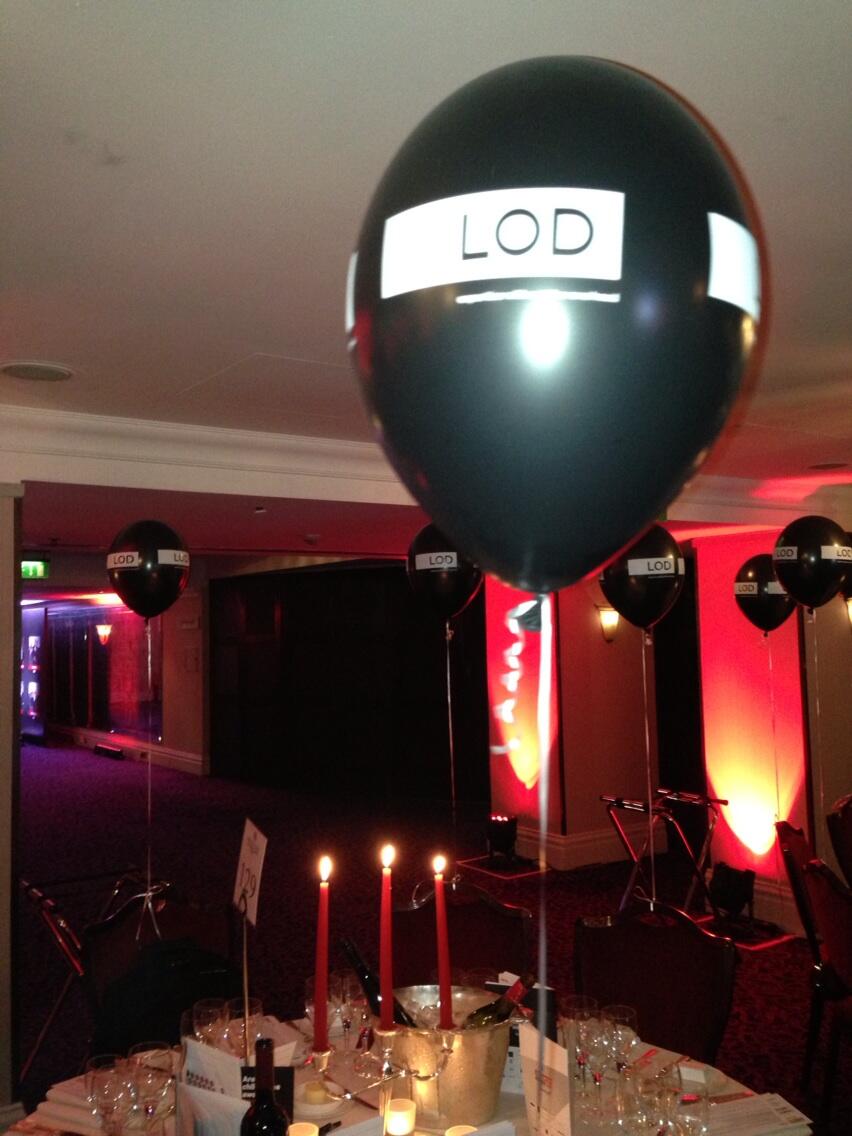
I was in fact the very delighted guest of Lawyers On Demand, one of the event's sponsors. These guys are exceptionally good company so the evening was particularly fun. Never shy of breaking the mold, they decided that sponsoring an award would be (unquote) "boring" so decided instead to sponsor some balloons. Of course! Balloons were tied to the back of every single dining chair, all emblazoned with the LOD logo. As guests entered the Grosvenor House grand ballroom, they were invited to pop their balloon before they took their seats, to see if they had won a prize. With mini iPads among the surprises, this got everyone very excited even before they sat down! Talk about differentiating your brand and proving you do things differently! Nicely done LOD! =)

The evening continued to sparkle from there. Lovely to catch up with so many old friends, all shortlisted for market-leading work - Mayer Brown's litigation team for their work on the groundbreaking NewCap Re caseSipara, shortlisted as Boutique Firm of the Year; Ben Rose of Hickman & Rose, shortlisted for Client Partner of the Year; Lindsay Scott of Matrix, her set shortlisted for Chambers of the Year; also Kysen alumni Fred Banning, now at Pinsent Masons who were shortlisted for several awards, and Sonia Malhotra now at Taylor Wessing - I got a real glow from watching her join her colleagues on stage to collect the big prize of the night: Law Firm of the Year.

Lots to celebrate! And that, we certainly did. =)

Monday, 24 June 2013

Ben Posford


Ben Posford is a complex man with interesting views on the line between individual and corporate responsibility. He is a claimant personal injury lawyer (a partner at Osbornes Solicitors) specialising in complex brain and spinal cord injury cases, and one of the 'hero' types that Neil Kinsella talked to me about previously in The Conversation, motivated to stand up for the little man or woman in the face of the large corporate monolith refusing to take responsibility for not looking after people properly.  A far cry from the image of the cynical, money-grabbing, ambulance-chasing, PI lawyer that some would have us believe is the norm.

Ben talked to me this week about the nonsense that is the Corporate Manslaughter Act and how the firepower it was supposed to bring has been little more than a damp squib.

"The idea of the Corporate Manslaughter and Corporate Homicide Act 2007 was that in addition to financial penalties, companies could be named and shamed to the extent they might have to carry a notice on their letterhead for a specified period of time after an offence saying they had been convicted under the Act.  But in practice, companies simply won't wear this, so instead they dissolve and then reappear in a different company shell with a new name - the same business, just re-housed and re-badged to get out of having to carry the slogan telling everyone of their offence. Gross negligence manslaughter is far better because it seeks to lay the blame at the door of individuals, and that is far harder to wriggle out of. But there's a balance: of course it's not right when individuals are hung out to dry by their employers when a problem lies with the system, or the culture, or management of a workplace. But businesses are run by people and the buck has to stop somewhere, particularly once the trail of responsibility leads you inside the senior management team."

Our conversation then took a tangential turn and we started to talk about parallel issues in other areas of law: from last week's Supreme Court judgment in the Prest divorce case, in terms of the use of corporate structures to hide things being put under scrutiny (the key issue here was whether the corporate veil could be pierced if it might be being used to hide assets of a divorcing party); to this week's publication of the Banking Commission Report, a major feature being the switch of focus to holding individual bankers to account, rather than the nebulous concept of "banking culture".

So in three very different areas of law we are seeing something of a fashion for corporate structures being ignored where they get in the way of personal responsibilities. A significant shift in the balance between individual versus corporate responsibility.  The latter may be great in theory, but perhaps we have learned that in practice it's too often used for individuals to slide out of responsibility.  The concept of corporate accountability was never intended to provide unscrupulous individuals new places to hide...
***
Some of you will know I'm a fan of Ray Bradbury's dystopian Fahrenheit 451, particularly Francois Truffaut's version of the story. I mentioned it in a blogpost this February, commenting on London Fashion Week's craze for Instagram diaries, which set me wondering we're inching towards a world where visual communication takes over from the written word. Imagine my delight when in response I was contacted by a fellow Fahrenheit 451 fan who has created this wonderful video summarising not just the plot but the underlying themes of this classic tale in under three minutes. It uses stop-motion edit technique, which you'll enjoy.

He makes some particularly interesting points about the relevance of this narrative in the modern day. Originally written in the days of McCarthyism, Collins considers the themes just as relevant in today's surveillance-obsessed world. 

You can see the video here. Enjoy!
***
BBC Correspondent Joe Lynam is more used to delivering, rather than making, the news. But this week he and his partner made headlines themselves as their dash to the maternity hospital ended up with the delivery of a second son in the front seat of the family Vauxhall Astra.

We had been surprised earlier in the week when a Newsnight opportunity we'd lined up was cancelled at the last minute as he took an unplanned day off when Riina went in to labour. The next we knew was an email the following morning headlined "Wow. What a night!" announcing the arrival of Sean Martin Lynam (3.2kg) and signing off "Riina is fine, but dad is in need of sedatives :)"

Benedict Moore-Bridger wrote up the story for the Evening Standard and it is currently one of the most read on the website this week. 

Congratulations Joe! But are these really the lengths you expect us to go to now, to make headline news??