Wednesday, 24 July 2013

Anne-Marie Kruk


Anne-Marie Kruk has Something on the Brain and insists we should be talking about it. She's working hard to break down barriers, shift preconceptions and get more people talking openly about it. She says a lot of harm is done by people feeling uncomfortable about it, being coy, brushing the issue under the carpet and avoiding discussing it directly. This is exactly how misconceptions about it are perpetuated she says. And what is this elephant in the room? Epilepsy.

"There are so many assumptions made about epilepsy - that sufferers can't ever drive to name just one. That it is totally incapacitating so impossible to live a normal life if you have it, to name another. This is so unhelpful and can be a real block to ordinary people being included in activities - even disadvantaging them in the jobs market. These misconceptions can stop epilepsy sufferers leading fulfilled lives and that's such a shame.

"It's a simple step forward, but I really think that by starting to speak out about epilepsy, some of the stigma and misconceptions around the condition will disappear." Anne-Marie has started a campaign aimed at doing just this: Something on the Brain - speaking out about epilepsy. "We want to get people talking about epilepsy, connecting with new people and sharing their own experiences with the condition. In particular we want to take this message onto the streets, into schools and universities etc, so we have a chance to make a real impact on lives that are still forming. The aim is not only to change the way people think of epilepsy, but be a friend to those with epilepsy too." Given she is targeting the next generation, it's no surprise her awareness raising campaign focusses on Facebook, Twitter and Pinterest as well as a website. 

"We also want to re-write the checklist of what to do when someone has a seizure, because the list of first-aid pointers we've all grown up with just isn't that helpful - eg making sure the individual doesn't swallow their tongue. It's now known to be a physical impossibility to swallow your own tongue!"

In the nicest possible way, Anne-Marie ambushed me into a photo-opportunity when we met, thrusting an inflatable microphone (the symbol of her campaign) into my hand and snapping me to add to her online photo-board. "My hope is to get the microphone pictured everywhere with people from around the world, and start an epilepsy awareness revolution!" she enthuses.

You know, seeing her passion about the subject this week, and the wonderful creativity she is putting in to her campaign, I believe she will.

If you would like to have your picture taken with Anne-Marie's inflatable mike, appear on her photo-board and do your bit to raise awareness of the truth about epilepsy, you can drop her an email.
***
Law firm branding: look how far we've come! Lucy Burton's feature (The Age of Marketing) in the current edition of The Lawyer magazine sparked a lot of discussion in the marketplace. At least half a dozen people brought it up in conversation spontaneously as we went about our normal business this week. The Lawyer does have a knack for writing the features that everyone else talks about... If you haven't had the chance to get to read beyond the headlines and get to the detail of the piece, do make time to have another, more thorough read. The "Colour Me Legal" wheel particularly caught my eye, showing the distribution of Top 50 law firm branding across the colour spectrum and the number of firms clustered in the blue zone (11 firms, discounting those favouring turquoise) and the black (9 firms).

Takes me back to the earliest days of law firm marketing, when the first brochures appeared after the Law Society restrictions on marketing were relaxed in 1987. (Yes I've been around that long - you're too kind saying I don't look old enough!) Satirical cartoonist Ken Pyne drew this wonderful cartoon for The Times (above left) depicting the new dialogue emerging between design agencies and law firms. As you'll see the colour palette of choice in those days shows how lawyers simply weren't ready to step on to the colour wheel at all: "dependable grey", "solid grey", "honest grey", "long and established grey" preferred over "untrustworthy and bent cerise". There really were a lot of grey brochures around in those days! As I say, in 25 years we've come a long way...
***
The other most talked about story was of course the revelation that two love-hungry American ladies in London have compiled a list of Barrister "Hotties". Thankfully amid cries of "would we put up with this if it were about women?" There is a serious point there, but it didn't stop the legal masses (and most of the Kysen team too it has to be said) chortling into our cappuccinos. It wasn't long before Telegraph journalist (and Kysen friend) Patrick Sawer picked the story up and ran a marathon with it.

My beef with the ranking though is that it's hardly definitive. For example how can these ladies have missed the heartthrob QC who sent one jury member so a-quiver during one of the top murder trials in recent years that she sent him a love note... which of course had to be declared to the judge as she could hardly be considered independent, given her emotional proclivities. The jury had to be disbanded and a new one sworn in. Our QC was more than a little embarrassed and of course he was ribbed mercilessly by his fellow members. I won't name him as he has clearly worked hard to keep himself off the Hotties list.  Just think how many others have done the same. Remember, in the world of PR, sometimes the busiest jobs are keeping people out of the news.   

Monday, 8 July 2013

Richard Waller


From Wallace & Gromit to Saudi Royalty: Richard Waller's life at TLT is certainly varied. As regular readers of this blog will know, I caught up with our friends at TLT last week in Bristol at the firm's charity auction marking the start of Nick Park's "Gromit Unleashed" campaign to raise money for Bristol's Children's Hospital. This week I met Richard in London, where he is running the high profile case against Prince Al-Waleed bin Talal, a nephew of Saudi Arabia's King Abdullah in London's main commercial court in the Rolls Building, famous for hearing so many disputes between the world's super-rich. Did you know (all you litigators will...) that last year more that 60 percent of all cases in our commercial courts involved a former Oligarch or super-wealthy Eastern European Businessman? This year seems to be the turn of the Middle Eastern Very-High-Net-Worths. 

The story behind the law suit is highly exotic: the spat is over a luxury plane (worth 120m pounds owned by the prince. It has a jacuzzi. You get the picture.) and the value of Richard's client's close business relationship and personal friendship with the buyer, none other than former Libyan dictator Colonel Gaddafi. Mrs Sharab claims her go-between role was essential to the negotiations and is claiming the 10m pound consultancy fee she says she was promised, but never received. A particular coup for TLT is that Richard's case is apparently the first time that a member of a Saudi Royal Family has been cross-examined by a British QC. And what a grilling he was given! Headlines such as "Billionaire Saudi Prince branded capricious in court" have sped round the world. The court reports have been full of how evasive the Prince has been to Clive Freedman QC's questions. Judgment is yet to be handed down and of course we have no idea what Judge Peter Smith will decide, but it certainly gives a client a good feeling to see their opponent so reduced in the witness box. At the very least Mrs Sharab knows her legal team have done a good job!

But what I wanted to know was Richard's view of why so many overseas business men and women are choosing the London courts to fight their battles. 


"First and foremost overseas litigants recognise the English courts to be incorruptible and to provide fair and balanced justice.  London lawyers have built a first class reputation for handling large and complex litigation with innovative pricing arrangements.The UK legal system is one of the best in the world. Some would say the best. In an age where the other cornerstones of our democracy have been so badly damaged, not least the reputations of our political system and the journalistic profession, we should be very proud that our legal system is so revered and respected."

Well said Richard. Let's hope Chris Grayling is reflecting on just this as he reconsiders the Government's attacks on Legal Aid. 
***
Good to have both Sophie and Adele back in the office after their Glasto galavant. Weren't they lucky with the weather! Their wellies hardly got an outing. And Adele came back a decidedly sun-kissed shade. If you know her, you'll appreciate our surprise. What I wanted to know though, was whether the Rolling Stones lived up to expectation. What was their performance like? "Energetic!" was the definitive reply. 

Our Adele has strong views on how jibes about how old the group looked have been allowed to circulate freely. Age discrimination, surely! As Adele said, if the comments were anti-women or anti-gay, people wouldn't stand for them so why is laughing at oldies acceptable?

I enjoyed The Stone's performance, and the rest of Glasto on TV from the comfort of my home sofa. Now that does have something to do with age! :)
***
Perfectly timed for Independence Day this week, Covent Garden has welcomed two new major US brands to the neighbourhood. Two classic American restaurant chains opened their first UK stores this week, Shake Shack in the piazza and Five Guys on the corner of our street, Long Acre. Queues have been snaking around the block all week. Well, we do like to be the first with the trends in this part of town you know... 

A little (blue) bird told me @saysitstraight is planning to review them for us as soon as the queues die down! We'll post the link here as soon as she does. Thanks Nicky!

Tuesday, 2 July 2013

Ronke Phillips


Thankfully there are some reporters giving the now rather battle-weary journalist profession a good name. ITV News Senior Correspondent Ronke Phillips is definitely one of those. I first met Ronke at the Amnesty Media Awards in 2012 when she won a prize for unearthing the awful truth behind the Torso In the Thames story and her shock revelation that ritual killings are taking place in our very own Capital. I saw her again at this year's Awards as she stepped onto the stage a second time, winning for her coverage of the ritual killing of another child, Kristy Bamu. As I have said before, after all the press-bashing we have seen throughout the Leveson Inquiry, which quite rightly hauled the media to account for some shockingly murky practices, it is nice to be reminded that some journalists' motives are quite heroic. 

I was keen to know what motivates Ronke to work to such a high standard, sufficient to win an Amnesty Award two years running. She takes a degree of personal risk zoning in on such difficult stories and I was interested to know why she would take this risk, rather than going for an easier life. In particular I was keen to get to the bottom of how journalists like Ronke are wired, in contrast to their more cynical counterparts. 

"It may sound like a bit of a cliche, but I am a news junkie and I also strongly believe in giving a voice to those who, for whatever reason, are unable to speak up for themselves. 

For me journalism has never been about just covering the day to day agenda. I'm interested in the stories behind the headlines, the human angle. These days there is less money and time for this type of journalism but if you put up a good fight for the stories you believe in, you  will get the backing to cover ones that matter. I can be like a ferret when I get wind of a worthwhile story. Tenacity is often the best policy!

The "Torso In the Thames" story became an obsession for me for various reasons.  He was a defenceless child and like me he was Nigerian. It was the most despicable crime imaginable and I believe it is important he is not forgotten. The story behind my nomination for this year's Amnesty Award was also the murder of a child. Kristy Bamu was killed by members of his own family because they believed he was possessed by demons. 

Both stories were difficult to cover emotionally. It is never easy dealing with the murder of a child. Both suffered very brutal, very violent deaths. The details could really traumatise you if you allowed them to. Interestingly I have never felt I was in any real physical or personal danger.  I am Nigerian so that country and its people are familiar to me. Kinshasa was a different story. The remnants of the war are still very evident and although the people were friendly generally, there is still quite a lot of tension and hostility toward outsiders. We had a few tense moments; crowds attracted by the camera voicing their disapproval loudly and angrily. Thankfully we had a brilliant minder who managed to calm things down." 

I was also keen to know about the support Ronke gets from ITV News, and whether the Amnesty Media Awards can help in enabling journalists to get story ideas approved and funded.

"Being recognised by such a prestigious organisation like Amnesty is incredible. It 'validates' me as a journalist and hopefully means my ideas are given a little more credibility but ultimately pieces are commissioned because they are solid, worthwhile, interesting stories which need to be told." 

As our conversation draws to a close, her parting line is: "As for being a hero... I wish!"

Ronke, you may say that, but others would disagree!
***
Had fun visiting Gromit in Bristol this week. You will have seen that Nick Park's Gromit Unleashed charity campaign to raise funds for the new extension to Bristol's Children's Hospital made national TV news this week, as 80 Gromit statues were moved into position in and around the city. 

TLT have sponsored one of the statues, painted by children's illustrator Hannah Cumming. And this week they held a charity auction at their offices to raise further funds for the hospital, timed to coincide with the "unleashing" of the Gromits. It was a lovely opportunity to catch up with some old friends in the TLT team and make some new ones. Nice to get reacquainted with Bristol too. One of my favourite cities. 

If you'd like to contribute to The Children's Hospital fund, you can make a donation here.
***
The Lawyer Awards was a glitzy affair this week. Those of you who know me well will appreciate the sacrifice I had to make, putting on my glad rags and spending an evening partying. But I took one for the team. 

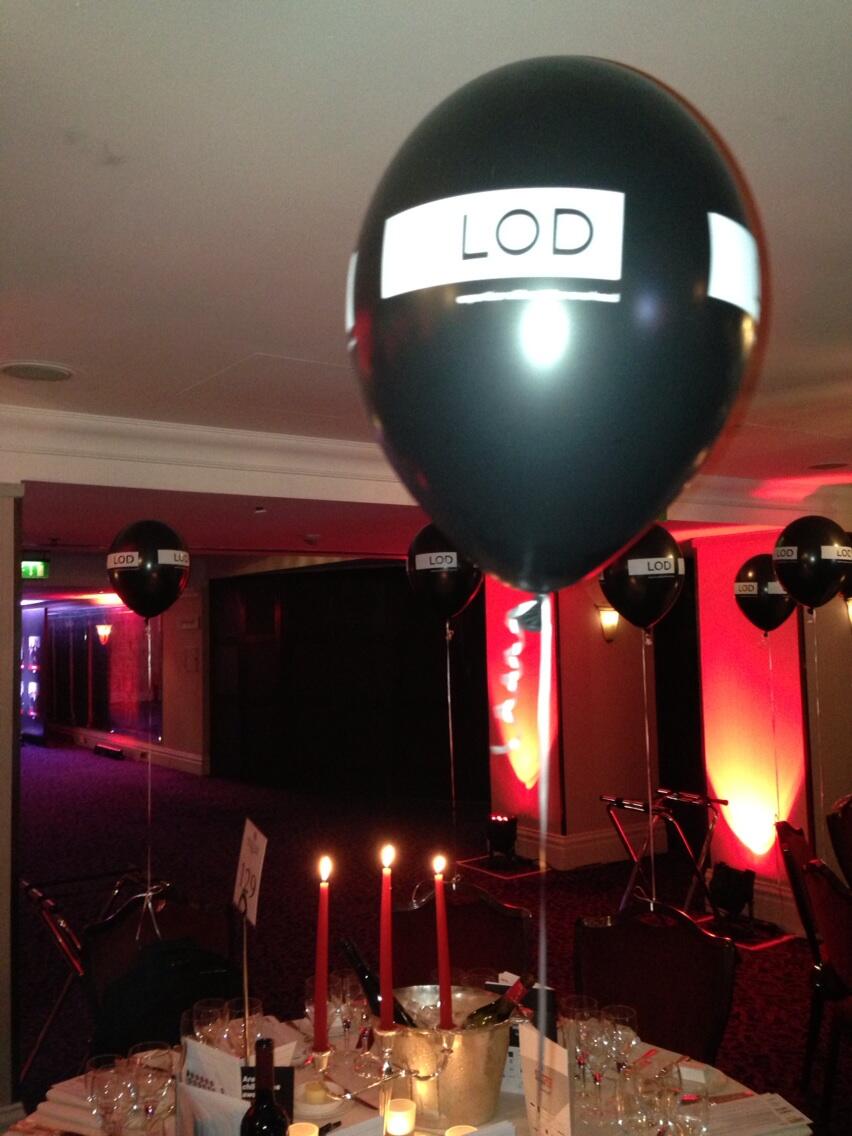
I was in fact the very delighted guest of Lawyers On Demand, one of the event's sponsors. These guys are exceptionally good company so the evening was particularly fun. Never shy of breaking the mold, they decided that sponsoring an award would be (unquote) "boring" so decided instead to sponsor some balloons. Of course! Balloons were tied to the back of every single dining chair, all emblazoned with the LOD logo. As guests entered the Grosvenor House grand ballroom, they were invited to pop their balloon before they took their seats, to see if they had won a prize. With mini iPads among the surprises, this got everyone very excited even before they sat down! Talk about differentiating your brand and proving you do things differently! Nicely done LOD! =)

The evening continued to sparkle from there. Lovely to catch up with so many old friends, all shortlisted for market-leading work - Mayer Brown's litigation team for their work on the groundbreaking NewCap Re case; Sipara, shortlisted as Boutique Firm of the Year; Ben Rose of Hickman & Rose, shortlisted for Client Partner of the Year; Lindsay Scott of Matrix, her set shortlisted for Chambers of the Year; also Kysen alumni Fred Banning, now at Pinsent Masons who were shortlisted for several awards, and Sonia Malhotra now at Taylor Wessing - I got a real glow from watching her join her colleagues on stage to collect the big prize of the night: Law Firm of the Year.

Lots to celebrate! And that, we certainly did. =)

Monday, 24 June 2013

Ben Posford


Ben Posford is a complex man with interesting views on the line between individual and corporate responsibility. He is a claimant personal injury lawyer (a partner at Osbornes Solicitors) specialising in complex brain and spinal cord injury cases, and one of the 'hero' types that Neil Kinsella talked to me about previously in The Conversation, motivated to stand up for the little man or woman in the face of the large corporate monolith refusing to take responsibility for not looking after people properly.  A far cry from the image of the cynical, money-grabbing, ambulance-chasing, PI lawyer that some would have us believe is the norm.

Ben talked to me this week about the nonsense that is the Corporate Manslaughter Act and how the firepower it was supposed to bring has been little more than a damp squib.

"The idea of the Corporate Manslaughter and Corporate Homicide Act 2007 was that in addition to financial penalties, companies could be named and shamed to the extent they might have to carry a notice on their letterhead for a specified period of time after an offence saying they had been convicted under the Act.  But in practice, companies simply won't wear this, so instead they dissolve and then reappear in a different company shell with a new name - the same business, just re-housed and re-badged to get out of having to carry the slogan telling everyone of their offence. Gross negligence manslaughter is far better because it seeks to lay the blame at the door of individuals, and that is far harder to wriggle out of. But there's a balance: of course it's not right when individuals are hung out to dry by their employers when a problem lies with the system, or the culture, or management of a workplace. But businesses are run by people and the buck has to stop somewhere, particularly once the trail of responsibility leads you inside the senior management team."

Our conversation then took a tangential turn and we started to talk about parallel issues in other areas of law: from last week's Supreme Court judgment in the Prest divorce case, in terms of the use of corporate structures to hide things being put under scrutiny (the key issue here was whether the corporate veil could be pierced if it might be being used to hide assets of a divorcing party); to this week's publication of the Banking Commission Report, a major feature being the switch of focus to holding individual bankers to account, rather than the nebulous concept of "banking culture".

So in three very different areas of law we are seeing something of a fashion for corporate structures being ignored where they get in the way of personal responsibilities. A significant shift in the balance between individual versus corporate responsibility.  The latter may be great in theory, but perhaps we have learned that in practice it's too often used for individuals to slide out of responsibility.  The concept of corporate accountability was never intended to provide unscrupulous individuals new places to hide...
***
Some of you will know I'm a fan of Ray Bradbury's dystopian Fahrenheit 451, particularly Francois Truffaut's version of the story. I mentioned it in a blogpost this February, commenting on London Fashion Week's craze for Instagram diaries, which set me wondering we're inching towards a world where visual communication takes over from the written word. Imagine my delight when in response I was contacted by a fellow Fahrenheit 451 fan who has created this wonderful video summarising not just the plot but the underlying themes of this classic tale in under three minutes. It uses stop-motion edit technique, which you'll enjoy.

He makes some particularly interesting points about the relevance of this narrative in the modern day. Originally written in the days of McCarthyism, Collins considers the themes just as relevant in today's surveillance-obsessed world. 

You can see the video here. Enjoy!
***
BBC Correspondent Joe Lynam is more used to delivering, rather than making, the news. But this week he and his partner made headlines themselves as their dash to the maternity hospital ended up with the delivery of a second son in the front seat of the family Vauxhall Astra.

We had been surprised earlier in the week when a Newsnight opportunity we'd lined up was cancelled at the last minute as he took an unplanned day off when Riina went in to labour. The next we knew was an email the following morning headlined "Wow. What a night!" announcing the arrival of Sean Martin Lynam (3.2kg) and signing off "Riina is fine, but dad is in need of sedatives :)"

Benedict Moore-Bridger wrote up the story for the Evening Standard and it is currently one of the most read on the website this week. 

Congratulations Joe! But are these really the lengths you expect us to go to now, to make headline news?? 

Tuesday, 18 June 2013

Megan Murphy


Fast FT’s Megan Murphy has a lot to say about the role of journalists in an age where citizens break their own news. Megan is running the FT’s revolutionary new direct-to- mobile news service, which launched at the end of May promising market-moving news and views 24 hours a day.

The idea is that the FT’s world-leading financial journalists, working together across different time zones, can bring you the stories you need to know as they happen, wherever they happen, and wherever and “whenever” you happen to be.

“Forget front page exclusives! Forget by-lines and physical paper! The web and social media have totally revolutionalised breaking news, and journalists need to think differently today about both input and output: how they approach stories; and how they process and deliver news. Today’s consumer of news doesn’t need it dressed up. It’s all about accessibility: people’s time is so compressed, they need their news on the move, wherever they are, whatever console they have to hand – mobile, iPad, desktop, whatever. What’s needed is a simple, straightforward straight-to-mobile service from a reliable source.”

We talked about the launch of GuardianWitness, her rival paper’s response to the explosion in citizen journalism, creating a platform for readers to submit their own videos and stories. Surely citizen journalism undermines the role of the traditional journalist? I ask her.

“I have a lot of respect for what The Guardian is doing and of course citizen journalism is having a big impact on what we’re doing at the FT; we are able to engage with the people consuming our content to a far greater degree than before and that’s exciting. My view on citizen journalism is that it actually puts our role as professional journalists into sharper relief; what I mean is, our skills are more valuable than ever before because in this age of information overload, people need to know which stories they can trust and they need context. Yes Twitter, and the ability for ordinary people to break news as it happens around them (here she cites the experience of how the story of the Boston bombings firstreached the public) is most definitely a threat to news organisations if they don’t respond to how people’s news consumption habits are changing. And let’s face it, as an industry we have been painfully slow to facing up to this change and adapting our models. We are under threat of the market being eaten up by far less credible competitors. But, what the FT offers is authority, as a news organisation you can trust to be accurate, unbiased and to put things into the correct context. I believe passionately that there’s a fantastic opportunity for the FT to say to readers, you know we have the world’s best journalists, that we are the world leaders in providing financial markets information and analysis and now we can match the less credible sources in terms of the ability to break news fast and get it to you in the way (and in the time) you need it. There’s no-one in the world who can do this for you better.”

Megan’s emphasis on the value professional journalists can add in terms of putting stories into context and helping people sift what’s significant and what’s not, puts me in mind of Legal Cheek editor and Guardian freelancer Alex Aldridge’s idea of journalists as “curators” of news.

“I think that’s a good analogy” says Megan. “We call our new digital drive at the FT “Digital First” but of course it’s not really about technology at all: it’s about attuning our content to readers’ needs. Perhaps we should have called this strategy Readers First.”
***
We love Netmums' Father's Day challenge to the "Dimwit Dad TV Stereotype". Citing such cult TV characters such as the hopeless Homer Simpson, the ineffectual father in My Family played by Robert Lyndsay, Hugh Dennis's inadequate dad in Outnumbered, even Peppa Pig's porky pa-pa. and all these hopeless male role models are paired with smart-thinking, practical, competent women. Netmums surveyed 2000 parents and found that most simply don't find this funny any more. It no longer resonates with the reality of most modern day families, where dads often have just as full-on a role at home. TV writers need to get with the programme and re-write this very tired script.  We wouldn't stand for such one-dimensional (and frankly discriminatory) treatment of mum characters these days after all). Let's respect the Dads in our families this Sunday. And let’s continue respecting them long after.
***
This week’s Amnesty Media Awards was a surprisingly uplifting event.  As I said last week it's always nice to be reminded in these post-Leveson days that some journalists really are heroes. 


You can see the shortlisted and winning stories here. A warning: Some of them are quite disturbing. It's a real eye opener as to what really goes on a lot of the time in other parts of the world.  But of course it's precisely because these tales are so harrowing that the journalists who risk so much personally to bring them to our attention should be so celebrated.


Another nice surprise on the evening was to hear a special mention given to Kysen friend, and multi award-winning journalist, Mira Bar-Hillel for a particularly moving article she wrote in The Oldie the plight of Israel's African refugees.  We are proud to know her!

Sunday, 9 June 2013

Sallie Bennett-Jenkins


Sallie Bennett-Jenkins’ work/life juggling act makes my life as MD of Kysen and mum of three (including twins) look like a leisurely stroll around Covent Garden piazza.  This lady balances a career as one of our top criminal QCs with a home life focussed on triplets of 16, twins of 13 plus a singleton of 11.  No, you haven’t made a mistake with your arithmetic; that’s six children altogether!

I first met 2 Hare Court’s Sallie a month ago when she kindly stepped in to do a Sky News interview for us that a client was unable to fulfil (about typical sentences and time served on the day Huhne and Pryce were released from custody).  We met in Temple at the crack of dawn to prepare for an 8.30 interview outside the Royal Courts of Justice and even at this unreasonable hour of the morning she looked polished and utterly immaculate.  In the words of former Evening Standard journalist, author and screenwriter Allison Pearson, “I don’t know how she does it”!

I spoke to Sallie again this week, keen to hear her take on the current Legal Aid row and how lawyers’ worries about threats to access to justice are so often misrepresented by certain parts of the media.  As one of our top-earning criminal QCs, her name was mentioned in a classic example this week: a Daily Mail piece naming the lawyers on the so-called “legal aid gravy train”.

“The article published this week is an example of the way the Government seeks to ignore the critical work we do in relation to the liberty of the individual.  Let’s leave aside the fact that the figures the Mail suggested I personally was paid per annum were nothing of the sort: they were sums earned over two or three years, not one; they included VAT at 20% and made no allowance for income tax and practise expenses I have to pay, nor for travel. None of this was explained. They do not reflect the fact that barristers have to make arrangements for their own pensions, they have no provision for payment if taken ill, and do not receive any paid maternity leave. The impression deliberately created was highly misleading.

The far more harmful problem however, is that the real issues in this debate are being distorted beyond recognition, which really doesn’t help a sensible public discussion.  The press often use the term that we as lawyers practising in criminal law are "defending criminals". We are not, we are representing those accused of crime by the state and who are innocent until proved guilty.  We have to remember some 45% of all people charged turn out to be innocent. A robust defence of those accused of crime lies at the very heart of a civilised system.

The example of Asil Nadir is often used to illustrate these sorts of pieces [indeed his photo dominates the Mail’s spread on the topic this week], as he famously rented a 23,000 pounds-a-month London residence for the duration of his 1m pound legal-aid-funded trial.  But this simply isn’t representative. 

It goes without saying, surely, that innocent people dragged through the criminal justice system need the protection and assurance that they will have access to the best legal representation  possible. The availability of a robust defence is essential to protect the integrity of our justice system; and it is critical to ensure that those who are innocent are acquitted and that convictions against the guilty are secure, and can’t be unpicked on the basis that a defendant was denied access to a proper defence.  After all, a rise in appeals resulting from an increase in unsafe convictions and miscarriages of justice will only mean a further drain on the public purse, so aside from the justice and human rights issues, skimping in this area is a false economy anyway.”

The Daily Mail piece quotes retired Court of Appeal judge Sir Anthony Hooper’s concerns that the withdrawal of defendants’ rights to choose their own legal representatives particularly hits those needing specialist expertise.  Sallie feels particularly strongly on this point: "In the last week, I have represented an 18 year old boy of good character accused of murder. He had much against him: preconceptions about his particular community in London; about the behaviour of young men men his age and his ethnicity; even his own timidity and inability to put himself across worked against him.

The conduct of his case demanded specialist skills in communicating with young people, those who are perhaps less able to express themselves, in order to draw out particular features that related to his defence. Over the course  of trial, we worked tirelessly, using all the skills garnered over nearly 30 years in practise, to test the evidence and to expose flaws in the prosecution case that lead to no evidence being offered against him. 

He left court able to return to his normal life rather than facing a sentence of life imprisonment with a minimum term to be served that would be expected to be in excess of 25 years.  His family wrote to me, expressing their deep gratitude for the way in which the case had been handled and explaining what an impact our work had had on their lives.  These are the sorts of stories that should be making the headlines in the debate about Legal Aid and the work lawyers do in this area.  But of course they never do.”

Justice Secretary Chris Grayling is quoted in the Mail piece saying that it is simply “not sustainable for tax payers to keep funding a legal aid system that has become one of the most expensive in the world”. But tell me, what happened to the Government’s pride in our world-leading legal system? When it comes to our commercial courts, the Government is only too happy to promote the fact we have one of the most enviable legal systems in the world, attracting cases from all over the world because judgments from the UK are so respected (and therefore more enforceable elsewhere).  We all know the statistics by now, that litigation involving former Russian oligarchs and other Eastern European parties accounted for an incredible 60% of all commercial cases in London last year.  It draws a very nice income stream in to the UK legal system. But of course our domestic criminal justice system can’t offer financial returns on investment in this way.  And in the absence of this, the Government appears to see these points about world-leading quality as a waste of tax-payers’ money.  This thinking simply isn't just.
***
We love the new FAST FT breaking news service! The irrepressible Megan Murphy, whom we first got to know at Bloomberg, then in her role as the FT’s law courts correspondent, is running the new service, which is highly appropriate given her reputation for living life at 120 miles per hour. 

The service, supported by a FAST FT Twitter account, promises "live reporting and comment on market-moving news" and is part of the FT’s new Digital First Strategy announced earlier this year. 30 journalists took redundancy at this time to make way for 10 new digital journalist posts. The face of journalism is changing fast. With Megan at the helm, this latest development is in very good hands.

***
So what did you make of the new Star Trek Into Darkness? Talking to friends, the opinion on this film is divided, Marmite-style. People seem to either love it (I did!) or hate it. But taking a poll in the office this week, I was shocked that half people in our team have not only never seen any of the Star Trek films or TV programmes, but deliberately give a swerve to any story centred on space, in fact any Sci Fi fare at all. "Too unrealistic", they say, and they simply "don’t see the point". I’m finding this hard to take in! One of the reasons this is a favourite genre for me is precisely what these stories have to say about our own society, altering one truth to show an aspect of our daily reality in sharp relief. Who doesn’t love the ongoing tussle in the Kirk-Spok bromance to prove whether "logic" or "gut-instinct" is the better strategy?  And of course the answer is that both are important and team-work is everything.  What's not to like!  Am I out on a limb here? Someone tell me I’m not alone... 


Tuesday, 28 May 2013

Dana Denis Smith


Dana Denis Smith hates to see good talent go to waste.  The award-winning founder of outsourced legal provider Obelisk tells me she is not as interested in the gender equality debate that surrounds discussion on flexible working, as she is in the economic view: issues around organisational capacity, labour market structures and how to be most efficient. She's a political economist by background and it shows. 

I was introduced to Dana by long term client and friend  Nicola Sawford, Chief Exec of leading Chancery barristers Serle Court, who has just taken on a non-exec role at Obelisk. When we met, I was interested to hear from Dana what drives her.

"My motivation is less personal than intellectual.  Having said this, I am of course interested in people's personal stories of how tough it is to be a working mum in a City law firm, and having previously worked at Linklaters and become a mum myself two years ago I do have some insights into what attracts our lawyers to our model.  But the point is I think it's now time to be less introspective and start getting things done.  For me, the interesting questions are "How much time does a mother have?", "How might this time be better utilised?" and "What can organisations do to enable them to work as well as to look after children?". It just makes no sense to me for organisations to sit back and just watch all this talent walk out the door when women find it impossible to juggle their work and family commitments in a large law firm environment. There's an enormous talent pool going to waste here. I often tell people I'm in the waste management business: talent waste management!" she laughs.

Regular followers of this blog will know that we work closely with the market leader in this area, alternative legal resource Lawyers On Demand who operate in a similar space to Obelisk but who are quite distinct in a number of ways. They are both tapping in to City lawyers' increasing ennui for a life that is all work and no play, enticing them into alternative working models that benefit corporate clients because of the City law expertise they can then buy from a much lower cost base. But whereas LOD focus predominantly on embedding their freelancers in in-house legal teams of FTSE 100 companies, so being physically proximate to the client and working as part of their own team a key part of the offering. Dana makes a big play on the Obelisk website that her lawyers don't even need to meet a client. And while both companies offer top ex-City lawyers, Obelisk focusses exclusively on people, mostly mothers, opting out of the big law machines have more time to devote to their families. In contrast, LOD attracts a broader range of individuals looking to work differently, with large numbers of men in their freelance pool as well as lawyers of both genders who don't yet have family but do have other ambitions outside of work, eg running a clothes-swapping initiative, a yoga business, they even have a part-time vicar!

Perhaps the biggest difference is that at its heart, LOD is fired by the founders Jonathan Brenner's and Simon Harper's passion for the glistening possibilities that open up for people when they choose to take control of their lives and live the life they really want to. In contrast, Dana's fire comes from wanting to challenge organisational structures, legal services supply chains and entire economies. She's also not shy to challenge clients in how they purchase legal services.

"Our clients know their stuff, for sure, but the point is they aren't used to having that many different options when buying legal services. So in challenging the status quo I do find myself having to challenge individuals too, to "gently encourage" them to think about buying their options differently."

Dana was named in 2010 as one of UK Management Today's 35 inspirational women in business under 35. No wonder.

***
So nice to catch up with clients and friends, old and new, at our Tonic event this week. 25 or so bods working in PR, marketing or management roles in professional firms joined us for camaraderie and conversation over drinks at The Hospital Club. We know people can feel quite isolated in these roles, working in a business that's about a very different discipline from your own, so nice to get everyone together and introduce them to each other. 

Particularly pleasing was to see how the number of Kysen alumni is growing! So lovely to see that Cara (now at Farrers), Sonia (now at Taylor Wessing) and Elliott (who recently joined the Conservative Party PR office), among others, are keen to keep in touch. Also nice to realise how long we have worked with some of our clients and friends. "Is it seven years we've been working together?" asked Serle Court's Nicola Sawford. And the lovely Helen Obi who joined Mayer Brown at the start of this year has also been our client twice before, at BLP last year and previously at DLA Piper. 

Other delights were conversation with peeps from BDO, Bird & Bird, BLP, Covington & Burling, Curtis Mallett-Provost Colt & Mosle, Hardwicke and Intangible Business.  
***
Happy 25th Birthday Tate Liverpool! As a regular Kysen haunt on our visits to Weightmans head office in the great Pool of Life, we feel some attachment to this gallery, the Tate's first foray outside of London.

Its success since opening in 1988 as a signature piece in the regeneration of the City's Albert Dock, has spurred the Tate on to open others around the country - notably on the beach at St Ives, Cornwall, and most recently in Tracey Emin's birth town Margate, The Turner Contemporary.. 

We love following this Tate "nationwide arts trail" and always try to make time to pop in and catch up with the latest exhibitions when we're on the road visiting law firms and barristers around the country. We look forward to more openings over the next 25 years!