Sunday, 13 January 2013

Katy Dowell


Katy Dowell is "up for 2013 and raring to go." At least that's what she told me when I spoke to her just as her Top 20 Cases hit the streets in The Lawyer's first print edition of the year. I was keen to hear the story behind the story as it were: just how does The Lawyer go about compiling this seminal piece of reporting on the litigation market? Just how do they manage to find out so much information about cases coming up in the year ahead, whilst most other publications are content merely to review the year that's past? 

"We do see this as one of our signature features and so we're prepared to throw a lot of resource at it" she tells me. As her editor Cat Griffiths points out in her Leader this week, The Lawyer's Top 20 cases has become "the essential guide to the biggest and hairiest disputes in the English courts" and is unique in being "anticipatory rather than retrospective research". "We start work as far back as mid-November," Katy tells me, "contacting more than 100 of our best contacts amongst the top clerks, all the major sets and top litigators in the big-hitting firms, asking them what they have on their books for the coming year. Selecting which cases to highlight was particularly difficult this year as there was so much to choose from - much more than last year. As I said in the feature, this is the year when credit crunch litigation is really starting to break through and that will bring with it problems for the banks". Almost half her Top 20 involve suits involving banks or financial institutions. "At the start of the credit crunch, in 2008/9, people were scared to sue the banks because they relied on them for financing. Also it was less clear at that time exactly where claims might lie. As time has moved on the true picture is starting to emerge and people are more adamant about bringing banks and financial institutions to account where they see a case to answer." 

In terms of other trends, Katy points out two: "the continuing rise of CFAs is interesting - the multi-million pound suit against Britain's richest man, steel tycoon Lakshimi Mittal, is being funded by a CFA. Also the continuing rise of the litigation boutiques - firms like Stewarts Law, Peters & Peters, Kingsley Napley and Enyo Law. In the days of the corporate boom" (remember those?) "litigators were the poor relations. But in these straitened times, this is now their moment: litigators have everything to play for and they don't want to be hamstrung by the sensitivities of their corporate colleagues and blocked from acting on the best of the cases in the market because of client conflicts. These boutiques have stepped into this space, particularly setting out their stall as being brepared to take on the banks. When you compare Stewarts' PEP of £926,000 with Clifford Chance's £933,000 it's clear they are on to something. 

"Of course for some, the thrill is still about being part of a cross-disciplinary, cross-jurisdictional team advising the top global corporates and the world's leading financial institutions. But for others the freedom to specialise in litigation and not worry about conflicts has more appeal (excuse the pun)."

Top 20 cases is one of the most well-read of The Lawyer's features in the year. This is not only the result of all the hard work from November by Katy and the team (Joanne Harris and Sam Chadderton provided additional reporting) but also the time and energy she invests in building relationships with the Bar throughout the year - her contacts book in this part of the legal world is second to none. Moreover she is clearly in her element and has emerged energised and excited from the task - presumably licking her lips at the thought of all those juicy litigation stories she'll be writing as the year progresses.
Well, we love reading your feature Katy – and look forward to your lively write-ups as each of your Top 20 opens in court. 

***
Good news for sex and age equality in the Oscar nominations list, out this week. Do we see signs that attitudes to older women are changing? (A subject very close to my heart!)

The Times' arts correspondent Jack Malvern reminded me of the story how Meryl Streep once famously illustrated the problem of institutional sexism and ageism in the film industry depriving fine actresses of good parts by telling how as soon as she turned 40 she was offered no less than three roles as a witch! But this year, two actresses spaced apart more than 70 years have both been nominated for Oscars: 9 year old Quvenzhane Wallis for her role in Beasts of the Southern Wild and 85 year old Emmanuelle Riva for Amour, respectively the youngest and oldest person ever to appear on the Best Actress shortlist. Are the times a changing? Now that would be a good start to the New Year.   

***
It looks an exciting year ahead in the arts world generally. Sumptuous reading this January as the papers set out the treats ahead over the next 12 months. I'm particularly excited about the Lichtenstein exhibition opening at the Tate Modern this February. Bound to be a busy exhibit though, as its comic book quirkiness has mass appeal across the generations. 

Click here for details of the exhibition.

Friday, 21 December 2012

2012 Review


What a year it's been!  Looking back at my 2012 blog posts, it's hard to believe so much has happened to a profession not really known - let's face it - for its revolutionary spirit.  Maybe all that's changing...

The year began auspiciously with Jomati Consulting's report After The Golden Age: The New Legal Era.  Tony Williams told the Conversation in January how the changes we were witnessing in the business of law firms were fundamental and permanent - and how only fools consoled themselves with the notion that normal service would resume once the economy returned.  And legal news stories breaking over the ensuing months only served to underline his point as the first licences for Alternative Business Structures (ABSs) were granted and firms made their market moves.


During the course of the year I was fortunate enough to have the opportunity to talk one-to-one with the people behind some of the most interesting stories: Neil Kinsella on RJW's merger with Australian law firm giant (and world's first listed law firm) Slater & Gordon; Jeremy Hopkins on the irrepressible rise of Riverview Law; Tim Oliver on Parabis's long awaited grant of its ABS licence - nervous regulatory  authorities taking an entire eight months to get their heads around an application for a structure designed to enable private equity investment; and solicitors regulation poacher-turned-gamekeeper Andrew Hopper QC, who was quite vocal throughout the year on what he called "the essential disconnect" between the bright strategic thinking at the top of the Solicitors Regulation Authority and the pettifoggers charged with administrating the new system on the ground.  O dear.  There have been some unhappy moments this year as a result of this disjointed thinking.  But Tim insisted he was confident the SRA has come to realise it needs to recruit some different thinking into this arm of its organisation and skill up - and he believes that although it was painful for Parabis being in the vanguard, the firm has at least paved the way for others following behind to have a smoother ride.


In the midst of all this market drama, a smile was raised by brand valuation consultancy Intangible Business.  Co-founder Thayne Forbes reminded us that in this Brave New World of legal services, particularly with new types of investor stepping in to the business of law, firms need to understand their "brand value" as never before.  We loved their Law Firm Chocolate Bar Challenge

And would you believe it, this chocolate-themed blog post was by far and away my most popular of the entire year.  Without a doubt.  See, I always told you lawyers are fun to work with!


We also enjoyed getting closer to some of 
the "esteemed mavericks" in the legal blogosphere.  The Conversation featured Mike Semple-Piggott talking about his famous Charon QC blog and being the most dangerous man in legal education; Professor John Flood on his Random Academic Thoughts blog and blowing students' minds; Alex Aldridge's Legal Cheek and how the increasing influence of the leading bloggers brings with it a new accountability - even for these men on the fringes of polite legal society. 

What interesting times we live in.


Merry Christmas everyone!  
If you haven't had a chance to view our wonderful video Christmas card, 
take a last look here before you break for the holidays.  

See you in the new Year!

The Conversation returns on 13 January 2013

Sunday, 16 December 2012

Buddy the Elf


Buddy the Elf says the Brave New World of Christmas Services has changed beyond recognition. Ever since Earthly Rewards Management Consultants got involved in the business of the North Pole, change seems to be the only thing that's constant. 

"I was nervous at first, not knowing how my world - my comfortable little life I'd been living for the past 200 years - would change", he tells me over a cup of hot cocoa in Covent Garden. "The first revolution was the outsourcing of our gift wrapping department to India. That was a shock. Colleagues and friends I'd known for a couple of centuries just suddenly weren't along the corridor from me any more and I had to adapt the way I did my own job to liaise with a completely new team of colleagues in a totally different location - who I would never get to meet face to face. The next shock was the outsourcing of the Naughty and Nice lists to a Managed Services Provider in Ireland. We all anticipated disaster. But I have to say that apart from one or two small glitches in the very earliest days, the transition has actually gone very well. And it's certainly lowered the level of stress we used to see around here. O my word! I remember that moment every year when Twinkle would be found in a heap of jangled nerves on the floor of the processing room, entangled in a never-ending ribbon of paper, her face the colour of her scarlet waistcoat. Thank goodness those days are over. 

We all worried that the Spirit of Christmas would be lost in this new efficiency drive, that quality would be compromised and the heart would go out of the business. But if anything, I think life has improved. At the North Pole, with all the non-core activity happening elsewhere, we can now focus on what we do best - and what I love doing best - hand-crafting toys for the children. Everything here is now focussed on that element and making sure we all do it to the very best of our ability.

And with our new "Elf Engagement Programme" giving us golden opportunities to talk to The Big Man about our daily lives and work, how things could be made more efficient, and at the same time how our working lives could be made more fun - we have developed a new company mantra: "Work to Live". I even have more free time now to keep in touch with my family and friends - including my old chums from the gift-wrapping department, now working for Amazon in the next town." 

So life is quite merry for our Buddy. And may your Christmas be too!

***
Here's a heart-warming seasonal story I stumbled across on Twitter -  a Christmas tree, a lawyer with an axe and an early present for some special needs children.  Chris Sutton is a paralegal in Mundays' Family team. He attended a Surrey business networking event last Friday where guests were invited to chop down  Christmas Trees on Barrossa Common. (Chris: "Don’t you wish all networking events were this fun?") Later, he was invited to take a tree back to the office, but as Mundays already has a beautifully decorated tree in its reception, he thought a more deserving home would be Portesbery Special Needs School in Camberley. 

This picture shows the tree in situ, now wonderfully decorated by some of the Portesbery children who are  severely autistic or have similar learning difficulties.

So lawyers have hearts? Most definitely. This is the proof.

***


I asked for a little help from my (twitter) friends, in making last minute suggestions for  books to buy the lawyer in your life this Christmas.  With only seven shopping days left til Christmas (yikes!), we thought you'll probably be grateful for any Amazon-enabled solutions.  
Here are some of the suggestions:

Always a fan of tales about innovation and revolution, @LegalTwo recommended Charles Arthur's Digital Wars, which recounts the story of the battle between Apple, Google and Microsoft and is interesting for anyone interested in seismic market change.  As @LegalTwo puts it, it's a story of "how lazy incumbents get found out by people who truly understand the customer experience."

@LBCWiseCounsel has a new book out this year that any forward-thinking lawyer will love: The Tale of the Old Badger, the Young Fox and the Wise Owl discusses the general topic of adapting to change and how to skill up to grab the new opportunities emerging.

Lastly, a reminder of two books out this Winter from Kogan Page that have featured in this blog before: David Tovey's Principled Selling - How to Win More Business Without Selling your Soul; and Jo Larbie and Heather Townsend's How To Make Partner And Still Have A Life.

Merry Christmas!

Sunday, 9 December 2012

Milan Dalal


Milan Dalal thinks professional advisors could gain a lot from listening to clients more. I know Milan as Director of Brook Intelligence Centre, but prior to this he had senior business development and comms roles at Grant Thornton and Olswang. I caught up with him shortly after his company had launched a new service via the Legal Week website. Legal Week Reports offers profiles of the world's top companies, in 10 key sectors, "to help law firms gain a better grasp of the businesses of clients and potential clients".

Over coffee our conversation turned to his thoughts on a recent report on "Effective Client-Advisor Relationships" produced by the FT in conjunction with Meridian West and the Managing Partners Forum"The continual feedback from the in-house lawyer community is that clients want their lawyers to understand the commercial context they're operating in, so how the advice they give plays out for the client in real life. For the client, legal issues are not theoretical. They are very real. But so often their legal advisors seem disengaged from this fact. 

"You see this at its most acute in pitches for new business. The best way for lawyers to win new business is to show that the legal team actually takes an interest in the client's business. It sounds so basic, but you'd be amazed how often lawyers will forget to do this. In a pitch situation particularly, their first instinct is to talk about themselves- their credentials, their expertise, maybe their knowledge of the target client's sector, with a little bit about the client's business tacked on at the end. In-house lawyers will always say that lawyers pitching to them should spend less time talking about themselves. The conversation should be flipped: far less "we are this, that and the other..." and far more "we've noticed this about you, we wondered if this or that may be an issue for your business". Lawyers can still pack in a lot of information about their strengths this way - in terms of knowing the law, understanding the sector and the business context. Instead of just talking about how they don't only give legal advice, they also help clients meet their commercial objectives, they are actively demonstrating it. 

"Professional advisors often don't get that clients will assume an awful lot about levels of expertise and legal skill. Lawyers wouldn't have made it on to the pitch list without these "hygiene" factors being taken for granted. So none of this needs to be covered in a pitch. Clients do buy business relationships though, so what matters to them is whether they can engage with the people in front of them. They'll be thinking about whether they could work with the legal team presenting". 

According to the Report, clients want a more strategic, commercial dialogue with their advisors, "particularly in a more complex, uncertain and global business environment". 

A big challenge. But at least the profession has Milan to help it rise to the occasion. 

***
What's the price of bad publicity? Apparently about £20m over two years. Neatly put - by barrister, media pundit and blogger Rupert Myers

It seems the only reason Starbucks has agreed "voluntarily" to pay more tax than legally required is because its UK customers expressed such outrage and anger at the company's position and threatened to boycott the coffee shop altogether. The story does sum up the point very neatly indeed. In the words of Starbucks UK Managing Director Kris Engskov speaking to Sky's Jeff Randall: "we have reacted to our customers... we have seen that doing business responsibly is good for the bottom line and this is a good example of that". Well, quite. 

***
Fun was certainly had at Kysen's "Magic of Christmas" party this week, as the team decamped to a vault room in the basement of Tuttons Bar on Covent Garden piazzaHoney and I managed to keep secret our surprise guest until the night: magician Stephen Barry, who amused and bemused us in equal measure with his mind-reading and sleight-of-hand magic tricks. His website (take a look- he does a lot of celeb events so you'll see some fun pics of an astonished Ant and Dec, a surprised Angela Griffin and a puzzled Harry Hill) claims that he can "make the impossible possible, close up and right in front of your eyes". And that's exactly what he did on the night. Definitely a fresh twist on the genre. For example, he got us reading his mind, guessing correctly which cards he was holding! 

Favourite moment of the night? A completely unintended one: Stephen, having wowed us into the palm of his hand, seeing Mariana's amazed gasp when he used her full name ("how did he know my name?")- before he pointed out he was only reading her table place name. We won't let you forget that one in a hurry, Mariana! 

Sunday, 2 December 2012

Jo Larbie

If you want to make partner and still have a life, Jo Larbie can tell you how. Jo is a talent management and professional development specialist who's worked with a variety of professional services firms over the last 15 years or so, such as Bircham Dyson Bell, DLA Piper, Stoy Hayward, Eversheds. I caught up with her just before the launch of her book, How to Make Partner and Still Have A Life - co-written with Heather Townsend and published by Kogan Page this week. It's a distillation of her knowledge and wisdom garnered over the years, condensed into something very practical, that readers can use as a guide for effecting change in their lives. 

"The phrase "Partner Material" is bandied about in professional firms to separate those associates who are from those that aren't" she tells me. "But no-one really knows what this means. This is a problem for firms, as well as those aspiring to partnership - not to mention those already in a partner role! And of course, today the partnership itself is changing - it's no longer the only career destination for top talent in professional firms. 

"From the individual's point of view, the key is to decide objectively if partnership is for them, and if it is, what they need to do to make that happen. My book is aimed at helping people unpick what "Partner Material" is, helping them decide whether it's a role they want, assist in the job of skilling them up for the task if they do want it, and also guide them through the conversations they need to have with managers and peers to make it clear to everyone that that's what they are aiming for and to seek their help and advice along the way. The days are gone when you could make partner by working very hard and someone just noticing you. Today you need to have an astute understanding of the targets the business is working to - ie what matters to senior management - and then make sure you are excelling at those things. And never confuse input with output!"

Jo says that talented people are often shy about broaching the subject of their ambitions with their bosses. "But it's all about how you present the issue. A good idea at appraisals is to say something like: "If I want to be a partner, what do I need to do? Can you tell me about your experience? How did it change for you? What should I think about doing differently?"

Some senior partners mistakenly think the different attitude of Generations X and Y is about a lack of commitment compared to their day. This is not true. Trainees and associates today just have different expectations of work and life. In particular, their time scale is different: they don't believe in deferred gratification. They don't want to be shut in a room and fed work, for some later prize. They want it all now - interesting and challenging work and time to enjoy a meaningful life outside of work! And considering that most young lawyers today come out of law school with a £30-50K debt, who can blame them!  My book attempts to shed some light and help spawn a generation of professionals who can enjoy both their work and their lives!"

I've ordered copies of How To Make Partner And Still Have A Life for several friends already. In my book, talent coach Jo Larbie is a very talented lady herself! You can buy it from Amazon here.
***

A good night was had by all at the London Solicitors Litigation Association's Annual Dinner this week.  The great and the good of the London litigation scene (Litigaterati? Maybe not) were there in force, treated to sumptuous food  in the Law Society's beautiful Common Room and a speech by Lord Falconer: wonderful tales of his role as Blair's first Justice Minister and the "fun" he had taking ministerial responsibility for the poisoned chalice of the Millennium Dome.  

But it was LSLA President Francesca Kaye that gave us the most food for thought.  In recapping on where we are with the Civil Justice Reforms, she raised a very interesting question: the current fashion for Oligarchs to stage their legal battles in London's is generating huge amounts of money (and therefore taxes) for the country, but why is this not being used to reinvest in the whole civil justice system and its infrastructure, such as IT, to ensure we can continue to provide the level of service that big litigation requires at the same time as benefitting everyone else in the system? When you think of all the cuts and the different imaginative and multifarious ways that Legal Aid is being withdrawn, "Why" indeed.
***
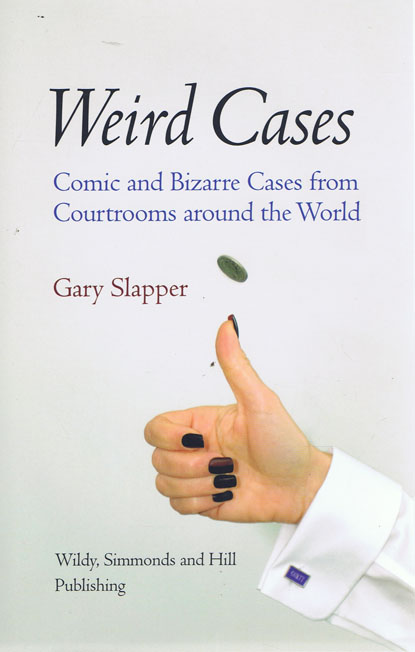
Stocking fillers for the lawyer in your life #2  Only 22 shopping days left till Christmas (yikes!) so we thought you might appreciate a couple more gift ideas for the lawyer in your life who has everything. New at the book store is of course Jo's and Heather's book on How To Make Partner and Still Have A Life, but for an old favourite you can't do much better than Gary Slapper's Weird Cases and More Weird Cases - comic and bizarre cases from courtrooms around the world. Here's a flavour:

"Courts have seen judges do things like try to turn off a musical tie playing "We wish you a merry Christmas" while sentencing a defendant to prison, fall asleep in the middle of trials, flip a coin to decide a case, demand a foot massage from a clerk, and get sentenced for judicial racketeering. Courts have listened to the defences like that of a bogus dentist caught using DIY tools on his patients and a man who based his defence on being as hapless as Homer Simpson...The cases featured in Weird Cases are those that truly stand out as odd, even among all the unusual dramas that challenge the courts. The chapters are: Compensation and Punishment, Love and Sex, Food, Drink and Drugs, Judges, Death and Violence, Pets and Animals, On the Road, Lawyers, and Jurors, Friends, and Neighbours."

Enjoy!

Sunday, 25 November 2012

Alex Aldridge


Legal Cheek founder Alex Aldridge didn't appreciate the influence he wields. He does now. It took a law suit and requests to his Internet Service Provider to close him down, before he realised how much notice people were taking of his maverick legal news site. 

"These days anyone can be a journalist. There's a whole variety of blogging sites enabling anyone to create their own content. But until Twitter, which has enabled everyone to push out that content to mass audiences in a way previously they could only dream of, people could blog away about their own personal view of the world to their hearts content, without really affecting anything; audiences were so small, any harm done would be limited.  But all that has changed."  Over lunch in Covent Garden I talk to Alex about whether the principles of ethics and standards that all good journalists subscribe to - accuracy, truthfulness, impartiality, objectivity, etc - have any special role to play as the authorities and users of social media alike try to get their heads around how we are going to control rights and responsibilities in this new social media age.  

I asked him if he thinks there's any difference between bloggers playing at being journalists, and journalists who blog. "I think the essential difference is about accountability. And it wasn't until that law suit that I really understood this in all its aspects."  "That" law suit centred on a story that was accurate, but which was accompanied by a photo of someone entirely unrelated to the affair. He wasn't the only journalist to use the photo erroneously - a leading daily paper had used the same image. But the mistake cost him dearly. "Legal Cheek started in the wild west days of legal blogging - a new frontier. With just me working on stories, for a then unknown blog, I had to be nimble and quick to get the stories first. No-one was going to deliver stories to my door." Now that he has recognised the influence his blog has, and the responsibility this carries, he takes a different approach. "I have to" he says. "There's an expectation that as a seasoned legal journalist, my stories can be relied upon and I'm accountable for that."

"It's interesting to see how Lord McAlpine's lawyers are calculating the damage to his reputation after the Newsnight/Phillip Schofield gaffe. They're basing it on the number of  followers the tweeters who named him have. They are arguing that those who have 56,000 followers, say, have a greater responsibility that those who have only two for example. And our Director of Public Prosecutions Keir Starmer is taking a similar approach. He has promised Guidelines later this year on how damage is to be calculated, after a series of cases involving social media abuse have resulted in wildly varying approaches to quantum. This is interesting: it's telling us not only about where the boundaries are in this wild west landscape, but also how responsibility and accountability are intrinsically linked to the strength of your following."

I also took the opportunity to ask Alex about a novel method of reporting we'd noticed recently on Legal Cheek.  You may have seen that his coverage of the Annual Bar Conference earlier this month took the form of a report of the most interesting tweets: "The Bar Conference In Tweets: Most Retweeted, Most Eye-Catching, Most Amusing".  For readers, this provided a fresh, novel way to learn what was being talked about, compared to the traditional journalist event write-up.  "It only worked by selecting the best from the #barconf2012 timeline.  Twitter timelines can in fact be very hard to read - it's not always obvious which tweet is replying to which, and how the thread of conversation is actually running. So a bit of deciphering was important to enable Legal Cheek visitors to understand what was going on. It's an interesting addition to the journalist skill-set. It's almost like "curating" - certainly it's more than just "aggregating".  It's an interesting role to have."

Well it's certainly interesting watching you develop Legal Cheek, Alex. I wonder where you'll take us next... 
***
News of another favourite legal blogger, in the dock this week for a highly entertaining distraction at London Twegals most recent tweet-up. The great and the good of the legal blogo- and Twitter-sphere gathered at The Lamb Tavern in Leadenhall Market to witness the Trial of Charon QC - entertainingly staged by This Is Your Laugh (this company should go right into your address book right away!) famous for putting on "individually-tailored comedy experiences" using Comedy Store and TV regulars: Norman Lovett the face of The Red Dwarf computer Holly, played Judge; and Bob Slayer, architect behind the Alternative Fringe at Edinburgh played defence. 
What a fun way to do a corporate (well almost) event!

Did we learn anything new about the legal profession's favourite blogger? 
- That there was a time when he was "never knowingly under-refreshed"? That was public knowledge (Rioja anyone?) and the man is now famously tee-total. 
- That his alter ego Mike Semple Piggott is the man who launched BPP Law School? We all knew that too. 
- That he has, in the words of his Lordship, "as many pseudonyms as any self-respecting rapper". But we know them all - Charon QC, Lord ShaggerDr Erasmus Strangelove and various other partners in Muttley Dastardly LLP, etc. And, as he was keen to point out, he has never hidden his true identity. 

It was the witness statements that were the revelation of the evening: a rather stressed @PME2013 tricked into donning a moustache and leading the crowd singing Queen's We Will Rock You (some in the room should be hanging their heads in shame); and @Jezhop managing to squeeze more key messages about his firm Riverview Law into his testimony than I have ever witnessed in legal circles :) 

Great fun night. If you missed it, watch out on Twitter for the next announcement about a Twegals Tweetup.

***
Don't get me started on the subject of women bishops! Can't think when I've been so disappointed with my beloved Church of England. I'm heartened by the fact that an overwhelming majority of the votes overall were in favour - also a majority in each of the three houses: House of Bishops, House of Clergy and yes, even in the House of Laity. The vote was scuppered by the antiquated voting structure requiring two-thirds support in each House. But surely the issue of women's leadership ministry in the church shouldn't even be in question!  

I'm confident the Stained Glass Ceiling, as this issue has become known, will eventually be removed. it's just a matter of time. Cast your minds forward: hope I live to see the day when the Church of England is arguing instead about the possibility of mandatory quotas for female bishops. Now there's a thought...

Sunday, 18 November 2012

Catriona Moore

Catriona Moore gives the phrase "unlocking potential" a whole new meaning. She is mum to five-year-old Amy who suffers from Rett Syndrome, a neurological disorder caused by a faulty gene that prevents the brain from communicating with the body and means her daughter cannot make any "purposeful" movements. Although Amy's brain is completely normal, she is unable to make the right connections with her own body - and thus neither with the outside world.  So Retts is a form of locked-in syndrome as communication - as well as walking, even eating and breathing - is severely impaired. 

"Unlocking potential" is a big theme in the world of personal and professional development, talent and human resources management, etc.  It's big business too. And in the world of professional services firms, where services are generally delivered through people, it is particularly key. Indeed it's a recurring theme in the conversations I have with law firm managers as I go about my business (and the subject of a book launching this month that I will be blogging about next week). But when Catriona told me the story of her beautiful little daughter Amy, how she worried when her development seemed so far behind her little friends, and became distressed when a number of the motor and other skills she was just mastering at about 18-months-old then actually started to recede - and the devastation that came with the knowledge the cause was Rett....I started to think about unlocking human potential in a whole new light.

We met at the third annual Reverse Rett London event to raise money for research into this devastating disease.  Catriona was one of the speakers.

"Rett Syndrome affects about 1 in 10,000 girls." Catriona tells me.  "Grief is something that's usually associated with death, with loss. Our little girl was alive. And yet in that traumatic period leading up to her diagnosis, we felt like we'd lost her. We were grieving for the loss of the girl we thought Amy was. The loss of our hopes and dreams for the sort of family we thought we'd be. As parents, the loss of peace of mind."

"But there is real hope and that is what we all focus on. A cure is tantalisingly close: the year Amy was born, 2007, an experiment on mice managed to reverse the disease entirely. We know that if the same applies when the treatment is given to humans, we really will be able to "unlock" our daughter's potential!

Catriona's husband, Amy's dad, is legal journalist and friend Eduardo Reyes, hence my invite to the dinner. The event was staged to raise funds to take this research to human clinical trials. "It is not just about preventing the disease to save the children of the future" Catriona insists. "The wonderful hope of this research is the potential to release children and others who are suffering today.  The disease was completely reversed in the mice trial.  We know Amy's brain is fine in itself - we had a scan recently - so if she could just be released from the Syndrome, she could finally lead a normal, care-free life! And if we can raise the funding, clinical trials could start in only two or three years. If we had the opportunity, we would sign Amy up for trials next week!" Rarely have I been to a charity fund-raiser where the possibility of reaching the end-goal, in this case a cure and means of reversing the condition for today's sufferers, was so tangible.  I was moved.

@joannaMG22 was also at the dinner and together with @edreyesjourno the three of us are now cooking up an idea for a legal Rett fundraiser. Could we persuade firms to donate just a small percentage of their talent management budgets maybe?? Do pass the word around. And watch this space for further details. But don't wait to donate! Click here to make a donation now.

***

Now that we can all play journalist in the new social media age, perhaps we need to take on some integrity points from the journalist tradition. Hardly a week passes without a story of an enthusiastic tweeter or blogger falling foul of defamation and other laws. 

Mark Leach at Weightmans put it well this week when he said on BBC London radio (nice placement Sophie!): "Now that we've got all these new toys to play with, all these social media websites, we will all get used to them in time I'm sure.  We'll grow up a bit in due course and get a bit more mature about them - use them with more respect. It's just that it might take a decade or so to get there!" Mark is an employment lawyer and he's noticed a sharp rise in cases relating to inappropriate comments on social media in the workplace. 

Of course we can all hope for a more mature attitude to social media use to emerge, but in the meantime any reputational damage done by irresponsible tweeters and bloggers is not so easily undone, whatever legal remedy is thrown at it. As Lord McAlpine put it, "There's a British proverb that's insidious and awful, that there's no smoke without fire. This is the legacy [this incident] has left me with." A very good point well made, and this from a man who certainly throwing a few legal remedies around as well.

***
Stocking fillers for the lawyer in your life. As we count down to Christmas (only 36 shopping days left!) The Conversation will offer some helpful gift suggestions for the lawyer in your life who has everything.

This week's recommendation is a book by one of our most favourite court reporters, The Evening Standard's Paul Cheston. "Court Scenes: The Art of Priscilla Coleman" studies the depictions of courtroom drama created by this iconic court artist who has worked for some 20 years for the likes of ITN and many of our daily papers.

Restricted from drawing in court, (along with any attempt at photography or other visual representation) court artists can only take brief written notes and then have to create the drawings afterwards from memory - and at high speed to make the daily press deadlines. Paul is one of the most experienced court reporters around and he covered many of the same cases as Priscilla. His commentary accompanying her sketches makes the book a particular delight. You can buy it here.

Some of the most famous trials are depicted - Rosemary and Fred West, Ian Huntley, The Hutton Inquiry, the 21/7 bombers and the moment Heather Mills-McCarthy poured a jug of water over her ex-husband's lawyer Fiona Shackleton. Priscilla's drawings have created many of the enduring mental images we store away in our memory banks about these high profile court stories. You will enjoy.